


You sit down with a Reading passage. The clock starts. You read the first paragraph carefully, then the second, then return to the first because a question has slipped your mind. Ten minutes later, you are still near the top of the page.
The problem is not that you read too slowly. It is that you are trying to read everything in the same way. IELTS Reading rewards a smarter habit: find the question’s clue, locate the relevant part of the text, and prove your answer with evidence. Think of it as an evidence hunt, not a race to finish every line.
This guide gives you a practical plan for Academic or General Training Reading in 2026–2027. You’ll learn how the test is structured, how to approach common question types, how to practise with Cambridge passages, and how to turn mistakes into a better next attempt.
First, know which Reading test you need
IELTS Academic Reading has three sections, 40 questions, and 60 minutes. The passages total about 2,150–2,750 words and come from sources such as books, journals, magazines, and newspapers. Each correct answer earns one mark. The test checks more than vocabulary: you may need to identify a main idea, find a detail, follow an argument, or understand a writer’s opinion or purpose.
General Training Reading also has 40 questions and 60 minutes, but its texts are different. Early sections focus more on everyday and work-related material, while the final section contains a longer, more complex text. Make sure you prepare for the module your university, employer, or immigration application asks for. Academic practice can build useful skills, but it is not a replacement for General Training practice, or vice versa.
For 2026–2027, practise in the format you expect to use. IELTS announced a move away from the traditional paper-based test from mid-2026, with exact change-over timing varying by market. A Writing on Paper option is available in selected markets, but Reading remains on computer. Check the format shown for your test date and location before booking.
Step 1: Take a baseline test before changing your routine
Before you buy another book or memorise a long vocabulary list, find out what is actually costing you marks. Choose one Cambridge Reading passage you have not attempted before. Set a timer and complete it without pausing to check answers.
Afterward, record four things:
- How many questions you answered correctly?
- How long you spent on each section or passage?
- Which question types caused the most trouble?
- Whether you could point to a line in the text that proved each answer?
That last check matters. A correct guess is not yet a reliable skill. If you chose an answer because it “felt right” but cannot find supporting evidence, mark it as uncertain in your tracker.
A simple record might look like this:
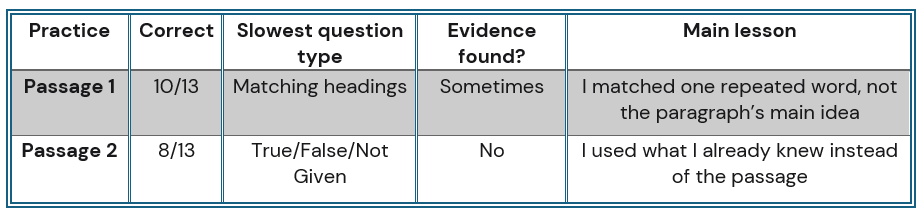

Do not judge your whole ability from one practice. Use the baseline to choose what to train next. If your accuracy is good but you run out of time, focus on pacing. If you finish quickly but miss many answers, slow down during evidence checks.
Step 2: Build four high-value Reading skills
1. Skim to map the text
Skimming means reading quickly to understand the general structure, not to collect every detail. Before answering, glance at the title, headings, paragraph openings, and any obvious changes in topic. Ask: What is this passage mainly about? Where does each paragraph seem to go?
Give yourself about a minute to make a rough map. It might be as simple as “history,” “problem,” “research,” and “solution.” This map helps you return to the right area later. It is not a summary to memorise.
Common mistake: reading every paragraph slowly before looking at any questions. That uses time without telling you which information matters.
2. Scan for anchors
Scanning means searching for a particular detail. Questions often contain names, dates, numbers, places, or unusual terms that are easy to spot. Underline one or two anchors in the question, then scan the passage for those anchors or likely paraphrases.
If the question asks when a project began, look for dates and time expressions. If it asks who developed a method, scan for names and job titles. Once you find a likely location, stop scanning and read that sentence plus the surrounding lines carefully.
3. Recognise paraphrases
IELTS often tests whether you can connect the meaning in a question with different wording in the passage. The same idea might appear with a synonym, a different part of speech, or a change in sentence structure.
For example, a question might say “the number grew quickly,” while the passage says “participation more than doubled in a short period.” The exact words differ, but the meaning is close. When you review a mistake, write down the question wording beside the passage wording. Over time, you’ll build a personal paraphrase list from real practice instead of memorising random vocabulary.
4. Verify the evidence and the logic
After locating a likely answer, read closely. Does the passage support the whole statement, or only one part of it? Is the author reporting a fact, presenting a possibility, or giving an opinion? Small words such as some, most, only, always, and may can change the meaning.
For True/False/Not Given, use this simple test:
- True: the passage supports the statement.
- False: the passage says something that contradicts it.
- Not Given: the passage does not provide enough information to decide.
Example: the passage says, “The library extended its opening hours in September.” The statement says, “The longer hours improved every student’s grades.” That result is Not Given unless the passage discusses students’ grades. It may sound possible, but possibility is not evidence.
Step 3: Use a different method for each question type
Matching headings:
A heading should describe the paragraph’s main purpose, not one memorable detail. Read the whole paragraph quickly, then summarise its point in five or six words of your own. Compare that summary with the heading options. Cross out headings that are too narrow, too broad, or focus on an example instead of the main idea.
True/False/Not Given and Yes/No/Not Given:
Read the statement carefully and split it into its key claim. Find the relevant part of the passage and compare meaning, not just vocabulary. For True/False/Not Given, the passage reports information. For Yes/No/Not Given, the question usually asks about the writer’s views or claims. Follow the exact instructions printed above the questions.
The biggest trap is treating “Not Given” as “False.” If the passage does not mention a claim, you cannot prove that it is false. Do not use your own knowledge to fill in missing details.
Sentence, note, or summary completion:
Check the word limit before you search. If the instruction says “NO MORE THAN TWO WORDS,” a three-word answer can lose the mark even if the meaning is correct. After locating the answer, read the completed sentence aloud in your head. Does it fit grammatically? Check spelling and whether the answer must come directly from the passage.
Multiple choice:
Read the question first and predict the kind of information you need. Then read the relevant passage closely and test each option against the text. Wrong options often contain one true detail but make a stronger claim than the passage does, or combine details from different paragraphs.
Do not select an option only because it repeats a word from the question. The correct choice is the one supported by the passage’s meaning.
Matching information or features:
For a question asking where a fact, example, or opinion appears, use names, dates, and distinctive terms as anchors. Mark the paragraph where you find evidence, then check whether the question asks for a specific person, a comparison, or an example. Read the instructions carefully: some sets allow an answer to be used more than once, and some do not.
Step 4: Pace the 60 minutes without rushing blindly
Forty questions in 60 minutes works out to an average of 1.5 minutes per question, but that does not mean every question deserves exactly 90 seconds. Some answers are quick to locate. Others require careful comparison or a return to the text.
The British Council suggests a 15/20/25-minute split across the three sections as a useful starting point. Treat it as a practice guide, not a strict IELTS rule. If your first section is consistently taking too long, train yourself to move on when you have checked the evidence once and still cannot decide. Leave a mark in your notes and return if time allows.
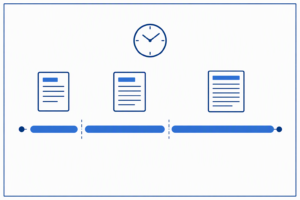

A practical rhythm is:
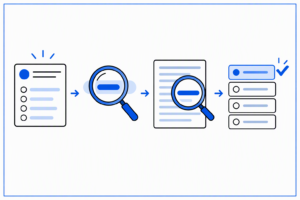
- Read the instructions and word limit.
- Preview the questions so you know what details to notice.
- Scan for anchors and paraphrases.
- Read the evidence closely before choosing.
- Move on if you are stuck, then return at the end.
In practice, note your time after each passage. If you regularly need 28 minutes for the first one, do not simply tell yourself to “read faster.” Find out whether you are rereading, translating every sentence, or getting trapped by one question.
Step 5: Follow a four-week practice plan
Use this as a sample plan if you have about a month. If you have less time, keep the order but shorten the weeks. Try to practise for 25–40 minutes on most study days, with at least one lighter day each week.
Week 1: Find your pattern
Take one timed passage early in the week. Review every answer, including correct guesses. On other days, practise one question type at a time. Keep a record of accuracy, time, and the reason for each mistake. At the end of the week, choose your two weakest areas.
Week 2: Train the weak skills
Spend one session on skimming and paragraph mapping, one on scanning, and two on your weakest question types. Use short passages or question sets. Your goal is to explain why an answer is supported, not just to raise the number correct.
Week 3: Add time pressure
Complete mixed question sets with a timer. Practise moving between questions and the passage without losing your place. Do one full Reading test near the end of the week, then spend at least as much time reviewing it as you spent taking it.
Week 4: Rehearse and refine
Complete one or two full practice tests in the format you expect to use. Review your error log and repeat a few questions from your weakest types. Avoid trying to learn dozens of new words the night before the test. Use the final study sessions to practise your process and settle into a steady pace.
Step 6: Turn Cambridge solutions into feedback
A Cambridge answer explanation is most useful after you have made a serious attempt. Try this five-step routine:
- Answer the question without opening the solution.
- Mark the sentence or paragraph you believe proves your answer.
- Compare your evidence with the explanation.
- Write down the paraphrase or logic you missed.
- Try a similar question later without looking at your notes.
For example, if you missed a matching-heading question, do not only copy the right heading. Note what the paragraph’s central point was and why the wrong heading sounded tempting. If you missed Not Given, identify which part of the claim the passage never confirmed.
This is how to use passage-by-passage Cambridge Reading solutions: attempt first, inspect the proof, learn the trap, and then test the skill again. IELTS Deal’s Reading solutions can support the review stage, but the score-building work happens when you explain the answer in your own words.
Step 7: Track progress with useful data
The latest IELTS test-statistics page available at the time of writing reports 2024–2025 mean Reading scores of 6.32 for Academic and 6.05 for General Training. These figures describe groups of test takers. They are not pass marks, personal predictions, or the score every candidate should aim for. Set your target using the requirements of the institution or organisation that will receive your result.
Also, remember that IELTS raw-score-to-band conversions can vary slightly between test versions. Use the conversion information supplied with an official practice test instead of treating one online score chart as exact for every paper.
Track these four measures after each practice:
- Accuracy: total correct and correct by question type.
- Evidence: whether you found a clear passage line for each answer.
- Time: minutes used per section or passage.
- Repeat errors: the mistake you keep making, such as over-reading, missing paraphrases, or confusing False with Not Given.
If your accuracy rises but timing slips, focus on locating evidence more efficiently. If timing improves but accuracy falls, slow down for the final proof check. A useful tracker shows both sides of performance.
Common mistakes to leave behind
- Reading every sentence slowly: preview the task, then read closely where the answer is likely to be.
- Hunting only for identical words: look for paraphrases and changes in sentence structure.
- Using outside knowledge: answer from the passage, even when you know the topic well.
- Spending too long on one question: make the best evidence-based choice you can, mark it, and keep moving.
- Checking only the final score: review why each error happened and how you will avoid it next time.
- Memorising a fixed band conversion: practice-test conversions are not guaranteed to be identical across versions.
Test-day checklist for 2026–2027
- Confirm whether you are taking Academic or General Training and check your test centre’s current delivery details.
- Practise reading on a screen if that is the format you booked. Get comfortable moving between the passage and questions.
- Read the instructions and word limits before answering.
- Use question clues to find likely paragraphs, then verify each answer against the text.
- Watch the clock, but do not panic if one passage feels harder. Keep moving and use your remaining time wisely.
- Before time ends, check unanswered items and review any answer you marked as uncertain.
The simple rule that changes your practice
Do not ask only, “Did I get it right?” Ask, “Where is the proof, what wording connects the question to the passage, and what will I do differently next time?”
Start with one Cambridge Reading passage this week. Attempt it under time, check the evidence, and log one lesson. Repeat the process. That steady habit will do more for your preparation than reading every passage twice and hoping the answers stick.


