
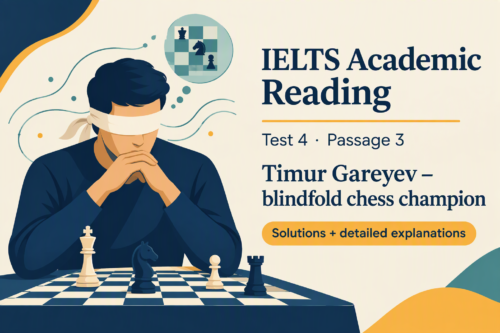
IELTS Academic Reading: Test 4 Reading passage 3; Timur Gareyev – blindfold chess champion; with best solutions and best explanations
This Academic IELTS Reading post focuses on solutions to IELTS Reading Test 4 Reading Passage 3, which is titled ‘Timur Gareyev – blindfold chess champion’. This is a targeted post for IELTS candidates who have big problems finding out and understanding Reading Answers in the AC module. This post can guide you the best to understand every Reading answer without much trouble. Finding out IELTS Reading answers is a steady process, and this post will assist you in this respect.
IELTS Reading Test 4: Academic Module
Reading Passage 3: Questions 27-40
The title of the passage: Timur Gareyev – blindfold chess champion
Questions 27-32: Identifying information
[This question asks you to find information from the passage and write the number of the paragraph (A, B, C or D … .. ) in the answer sheet. Now, if the question is given in the very first part of the question set, I’d request you not to answer them. It’s mainly because this question will not follow any sequence, and so it will surely kill your time. Rather, you should answer all the other questions first. And just like List of Headings, only read the first two lines or last two lines of the expected paragraph initially. If you find the answers, you need not read the middle part. If you don’t find answers yet, you can skim the middle part of the paragraph. Keywords will be a useful matter here.]
Question no. 27: a reference to earlier examples of blindfold chess
Keywords for the question: earlier examples, blindfold chess,
Paragraph D gives reference to earlier examples of blindfold chess. In lines 2-4 the writer says, “ .. . .. .. .. . The first recorded game in Europe was played in 13th-century Florence. In 1947, the Argentinian grandmaster Miguel Najdorf played 45 simultaneous games in his mind, winning 39 in the 24-hour session.”
Here, The first recorded game & in 1947 = earlier examples,
So, the answer is: D
Question no. 28: an outline of what blindfold chess involves
Keywords for the question: what, blindfold chess, involves,
In paragraph E, the writer says lines 2-4, “ . .. . . .. . The nature of the game is to run through possible moves in the mind to see how they play out. From this, regular players develop a memory for the patterns the pieces make, the defences and attacks. . . .. . .”
Here, the writer explains how the game is played.
So, the answer is: E
Question no. 29: a claim that Gareyev’s skill is limited to chess
Keywords for the question: claim, Gareyev’s skill, limited to chess,
In paragraph F, take a close look at lines 1-6, “ . . .. .. . The scientists first had Gareyev perform some standard memory tests. These assessed his ability to hold numbers, pictures and words in mind. One classic test measures how many numbers a person can repeat, both forwards and backwards, soon after hearing them. Most people manage about seven. ‘He was not exceptional on any of these standard tests,’ said Rissman. ‘We didn’t find anything other than playing chess that he seems to be supremely gifted at.’ . .. .. .”
Here, He was not exceptional & We didn’t find anything other than playing chess that he seems to be supremely gifted at = Gareyev’s skill is limited to chess,
So, the answer is: F
Question no. 30: why Gareyev’s skill is of interest to scientists
Keywords for the question: why, Gareyev’s skill, of interest, to scientists,
In paragraph B, lines 1-4 say, “But Gareyev’s prowess has drawn interest from beyond the chess-playing community. In the hope of understanding how he and others like him can perform such mental feats, researchers at the University of California in Los Angeles (UCLA) called him in for tests. . … . . .. .”
Here, researchers at the University of California in Los Angeles (UCLA) called him in for tests = Gareyev’s skill is of interest to scientists,
In the hope of understanding how he and others like him can perform such mental feats = why,
So, the answer is: B
Question no. 31: an outline of Gareyev’s priorities
Keywords for the question: Gareyev’s priorities,
The final paragraph (H) talks about Gareyev’s priorities. Take a look at lines 4-5, “ .. . .. .. . ‘The most important part of blindfold chess for me is that I have found the one thing that I can fully dedicate myself to. I miss having an obsession.’ ”
Here, The most important part of blindfold chess for me = Gareyev’s priorities,
So, the answer is: H
Question no. 32: a reason why the last part of a game may be difficult
Keywords for the question: reason, last part, a game, may be difficult,
Lines 9-11 of paragraph E give us answer to this question. Here, the writer says, “ .. . . First moves can be tough to remember because they are fairly uninteresting. But the ends of games are taxing too, as exhaustion sets in. . .. … .”
Here, the ends of games are taxing = the last part of a game may be difficult,
as exhaustion sets in = why,
So, the answer is: E
Questions 33-36: TRUE, FALSE, NOT GIVEN
[In this type of question, candidates are asked to find out whether:
The statement in the question agrees with the information in the passage – TRUE
The statement in the question contradicts the information in the passage – FALSE
If there is no information on this – NOT GIVEN
For this type of question, you can divide each statement into three independent pieces and make your way through with the answer. This question type generally follows a sequence. So, scanning skill is effective here.]
Question no. 33: In the forthcoming games, all the participants will be blindfolded.
Keywords for the question: forthcoming games, all the participants, will be, blindfolded,
In paragraph A, lines 2-3 say, “ .. . .. . While his challengers will play the games as normal, Gareyev himself will be blindfolded. .. .. . .”
Here, will play the games = forthcoming games,
his challengers = all the participants,
Gareyev himself will be blindfolded = NOT all the participants will be blindfolded,
So, the answer is: FALSE
Question no. 34: Gareyev has won competitions in BASE jumping.
Keywords for the question: Gareyev, won competitions, BASE jumping,
In paragraph A, lines 5-6 say, “ .. . .. . He has a fondness for bright clothes and unusual hairstyles, and he gets his kicks from the adventure sport of BASE jumping.. .. .. . .”
Here, the writer talks about Gareyev’s fondness for BASE jumping but doesn’t mention about wining any BASE jumping competition.
So, the answer is: NOT GIVEN
Question no. 35: UCLA is the first university to carry out research into blindfolded chess players.
Keywords for the question: UCLA, first university, carry out research, blindfolded chess players,
In paragraph B, the writer talks about the research into blindfold chess players, “ . . .. . In the hope of understanding how he and others like him can perform such mental feats, researchers at the University of California in Los Angeles (UCLA) called him in for tests. They now have their first results. ‘The ability to play a game of chess with your eyes closed is not a far reach for most accomplished players,’ said Jesse Rissman, who runs a memory lab at UCLA.. .. .. .. .”
Here, the writer saying NOTHING about whether UCLA is the first university to carry out research into blindfolded chess players or not.
So, the answer is: NOT GIVEN
Question no. 36: Good chess players are likely to be able to play blindfold chess.
Keywords for the question: Good chess players, likely to be able, play, blindfold chess,
In paragraph E, the first few lines say, “Accomplished players can develop the skill of playing blind even without realising it.. .. . . .”
Here, Accomplished players = Good chess players,
can develop the skill = likely to be able,
playing blind = play blindfold chess,
So, the answer is: TRUE
Questions 37-40: Summary completion with ONE WORD ONLY
[In this kind of question candidates are given a summary for one, two or three paragraphs with some fill-in-the-blanks questions. Candidates need to find out the related paragraphs by correctly studying the keywords from the questions. Then, they should follow the steps of finding answers to fill in the gaps.]
Question no. 37: The researchers started by testing Gareyev’s ______________;
Keywords for the question: researchers, started by, testing, Gareyev’s,
The first line of paragraph F has a word ‘first’. Let’s start reading there.
The writer says in lines 1-2, “The scientists first had Gareyev perform some standard memory tests. .. . .. .”
Here, The scientists = The researchers,
first had = started,
perform .. . .. tests = testing,
So, the answer is: memory
Question no. 38: . . .. for example, he was required to recall a string of __________ in order and also in reverse order.
Keywords for the question: for example, was required to, recall, a string of, in order, in reverse order,
In paragraph F, the writer says in lines 2-4, “ . .. . .. . One classic test measures how many numbers a person can repeat, both forwards and backwards, soon after hearing them. .. .. . .”
Here, repeat = recall, forwards = in order, backwards = in reverse order,
So, the answer is: numbers
Question no. 39: Although his performance was normal, scans showed an unusual amount of _____________ within the areas of Gareyev’s brain that are concerned with directing attention.
Keywords for the question: Although, performance, normal, scans showed, unusual amount of, within, areas of Gareyev’s brain, concerned, directing attention,
In paragraph F, lines 9-12 say, “ . . .. . . Though the results are tentative and as yet unpublished, the scans found much greater than average communication between parts of Gareyev’s brain that make up what is called the frontoparietal control network. . .. . ..”
Here, much greater than average = unusual amount of,
parts of Gareyev’s brain = parts of Gareyev’s brain,
make up = concerned with,
So, the answer is: communication
Question no. 40: In addition, the scans raised the possibility of unusual strength in the parts of his brain that deal with ___________ input.
Keywords for the question: In addition, scans, raised, possibility, unusual strength, parts of his brain, deal with, input,
In paragraph G, in lines 1-5 say, “ .. . . .. The scans also suggest that Gareyev’s visual network is more highly connected to other brain parts than usual. Initial results suggest that the areas of his brain that process visual images – such as chess boards – may have stronger links to other brain regions, and so be more powerful than normal. . .. .. ..”
Here, also = In addition,
may = raised the possibility,
the areas of his brain = the parts of his brain,
process = deal with,
So, the answer is: visual
Click here for solutions to Test 4 Passage 1: Bats to the rescue
Click here for solutions to Test 4 Passage 2: Does education fuel economic growth?



Thank you very much.
Could you please upload model answers and detailed analysis for Cambridge Academic IELTS 19 and 20 Reading tests?